The fun and versatility of the Dungeon Command series has made Flagoon and Revan huge fans of the game. Not only is the game wonderfully fun, but the good folks at Wizards of the Coast have included monster cards for each of the twelve monsters in each kit so you can repurpose them as foes in D&D Adventure System games like Wrath of Ashardalon and Castle Ravenloft. Also these great looking minis can be used in your table top, pencil & paper game as well!! But with all those choices, the straight Dungeon Command game is quickly becoming one of our favorites. In Dungeon Command you don’t have to worry about the luck of dice rolling in your favor, It comes down to pure strategy when going up against another commander’s mind. The action is quick and bloody and there is plenty of attrition. In Blood of Gruumsh, there are a half dozen types of Orcs to choose from – druids, chieftains, drudges, archers, clerics, and barbarians – as well as a boar, wereboar, an owlbear, and a big, mean, and nasty Ogre. Read our previous posts about Dungeon Command to get a better understanding of the game play and keep in mind that, while you can play the game with a single faction pack, Dungeon Command is intended to be played with a faction pack for each of the suggested two to four players. Blood of Gruumsh is in stores now so go pick up your copy today!
Diminutive Jedi master rumored to be first of several characters from Star Wars universe in line to feature in his own spinoff film.
An iconic figure he is, beloved of generations of children and adults alike. Now Yoda is rumored to be getting his own spinoff movie as part of Disney's new series of Star Wars films. News of the diminutive Jedi master's elevation from supporting character status comes following the announcement of a new trilogy of Star Wars films after Disney purchased all rights to the series for $4.05bn last October. The studio announced last month that Star Trek director JJ Abrams will take on the first movie, Episode VII, and screenwriters are already in place to take on the two subsequent installments. However, there have also been regular rumors that Disney plans spinoff films in a similar vein to the plethora of character-based superhero movies that have emerged in the past few years under its wholly-owned Marvel Studios banner. Now it looks as if Yoda could be coming out of retirement as part of plans put in place by new LucasFilm president Kathleen Kennedy. "The first standalone film is going to center upon Yoda. At this stage, specifics are sparse, but Kathleen Kennedy is putting together a Star Wars slate. "I've also heard tale of a Jabba story that Lucas has floated to some of his buddies. But word is Yoda is first." Yoda featured in all three of the prequel movies, though in the last two he was depicted in CGI rather than in original puppet mode, much to the chagrin of some older fans. The character was voiced (and controlled for the classic trilogy) by Frank Oz, the former Jim Henson collaborator who also brought Muppets such as Miss Piggy to life. It is not known whether the 68-year-old, who has made a career as a film director in recent years, is in line to return to the role. A Yoda movie could potentially throw a spanner in the works for Disney's previously announced plans to set the new Star Wars trilogy after 1983's Return of the Jedi. Were the Jedi master to appear in his own movie before turning up in the new trilogy, it would require some serious recon work, because Yoda died in that film. Nevertheless, the series has shown in the past that death need not be a barrier to returning in a future installment. Despite being killed off in the Return of the Jedi, Alec Guinness played Obi Wan Kenobi in two more Star Wars films.
I recently was invited to play in a new gaming group and it was just my luck that they were playing the new Iron Kingdoms RPG. So for the last few days I have been reading through the new Iron Kingdoms Core Rules book graciously provided by my GM for the purpose creating my character and learning more about the game.. And I have to admit I have been smiling from ear to ear all the time.
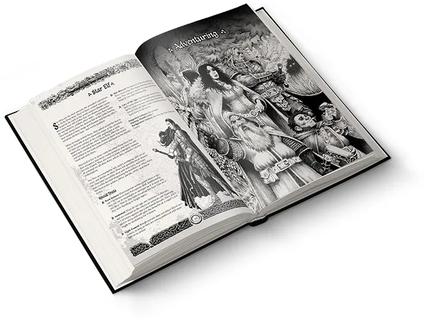
The new Iron Kingdoms Core Rules book is a 358-paged full-color hardcover book which contains all the rules and background needed to run games set in the Iron Kingdoms campaign setting. As expected from a Privateer Press product the production quality is extremely high. Artwork and layout are on par with what you’ve seen in any of the WARMACHINE products. It’s a pleasure just to leaf through the book and enjoy the artwork. Yes, it’s that good. The first section of the book (about 100 pages) focuses on the world of Caen in general and the area of Western Immoren in particular. You get a detailed description of the history of the Iron Kingdoms, the cosmology and an overview of life in Western Immoren. By the way, some of you might not have heard of the Iron Kingdoms before, so let me give you a short introduction: The world of Caen is not your regular fantasy world. Yes, there are the typical fantasy races you’d expect and yes, there is magic, but Western Immoen (which is the area the game is set in) also went through an industrial revolution, which led to all kinds of mechanical marvels like Steamjacks (coal-driven golems), trains, steam engines and firearms. The nations of Western Immoren which are also called the Iron Kingdoms were formed after the successful rebellion against the evil Orgoth Empire who had conquered the area four centuries earlier. Nowadays the Iron Kingdoms consist of the human nations of Cygnar, Khador, Llael, Ord, the Protectorate of Menoth, the dwarven nation of Rhul, Ios, the homeland of the elves and the hostile island nation of Cryx. The Iron Kingdoms are ripe for conflict and there are countless opportunities for adventures. The second section of the book (about 70 pages) is all about characters. Character creation in the IK RPG is a pretty straight forward process but allows for a huge variety of different characters. You start by choosing your character’s race (Human, Dwarf, Iosan (Elf), Nyss (Elf), Gobber, Ogrun, and Trollkin). After that you pick one of the four archetypes: Gifted, Intellectual, Mighty and Skilled. Each archetype grants the character with a special ability (like an additional die on melee damage rolls in the case of the Mighty) and allows the player to pick once from a list of benefits (like Photographic Memory or Genius for the Intellectual). Archetypes also play a role when it comes to picking careers. Each character gets to pick two careers. Some careers have prerequisites (like Gifted only or Human only), but aside from that you’re free to mix and match. In my opinion the career system is a stroke of genius. It takes the best aspects of class systems but none of the inherent problems. Class systems have the advantage that they make things much easier especially for new players like myself. But often classes can also be restrictive in certain ways. The careers in the IK RPG provide the character with a set of skills, abilities, spells (if the career allows spellcasting) and starting gear. Each career also comes with a list of skills and abilities a character following said career can learn in the future. By combining two careers you basically get a huge number of different combinations that allow for a wide variety of character types. You want to play a noble mage? Then combine Arcanist with Aristocrat. Your perfect character started out as a priest but decided to join the military instead, why not combine Priest and Soldier? The following careers are in the book: Alchemist, Arcane Mechanik, Arcanist, Aristocrat, Bounty Hunter, Cutthroat, Duellist, Explorer, Fell Caller, Field Mechanik, Gun Mage, Highwayman, Investigator, Iron Fang, Knight, Mage Hunter, Man-at-Arms, Military Officer, Pirate, Priest, Rifleman, Soldier, Sorcerer, Spy, Stormblade, Thief, Trencher, and last but not least Warcaster. After picking your career you get to increase your character’s stats (each member of a race starts with the same stat profile) and then you can apply some finishing touches. What I like most about the system is that character creation is very quick and quite straightforward while still giving the players access to a huge variety of character concepts. The Character section of the book also contains an extensive description of all the skills and abilities and gives examples for target numbers with each skill. Then after creating your characters the party comes together and picks from one of the available Adventuring Companies. These companies not only provide a theme and some special benefits, they also give a reason why the characters are working together. Choosing an adventuring company is of course optional and subject to GM discretion, but it’s another idea that could help players and GM to get into the game quicker. The third section of the book covers the rules of the game. I have to admit that I was actually surprised that the general rules section (including combat rules) is just about 30 pages. Skill rolls are done by rolling 2d6 and adding the relevant Skill Level and Stat. The result is then combined with a target number set by the GM. The game gives examples for appropriate target numbers for all the skills, but an experienced GM may basically use handwaving to come up with target numbers if he or she wishes to. Especially when it comes to non-combat actions the crunch level is surprisingly low. Things get a bit more complex when combat is involved and the Iron Kingdoms RPG shows its kinship to the WARMACHINE miniature game here. If you have played WARMACHINE or HORDES before, you should feel right at home. The rules recommend that you use miniatures and a battlemap for combat, but there are also guidelines for people who prefer not to. Ranges are given in both inches (for miniature play) and feet, which is something I wish other games would have done as well (D&D 4th Edition I am looking at you!). Explaining all the various combat rules would probably be beyond the scope of the review. If you wish to get an idea of what combat in the IK RPG looks like, check out the WARMACHINE quick start rules which are freely available on the Privateer Press site. As you would expect from a combat system based on a miniatures game there are rules for every situation and there’s not a lot of room for GM fiat when it comes to combat. The combat rules are also a bit more crunchy than I usually prefer but it’s definitely less complex than games like D&D 3rd Edition. One aspect of the combat rules I like a lot are the Life Spirals. In the case of simple NPCs the game usually just uses Vitality points to track damage. But in the case of important NPCs and Player Character the Life Spiral is used. As you can see to the right each character has a life spiral with 6 branches grouped into three aspects tied to the character’s main stats: Physique, Agility and Intellect. Whenever a character takes damage, you roll a d6 to determine where you start marking off Vitality points. Are there no more unmarked Vitality points in the branch, you move to the next one clockwise. If all Vitality points are filled the character succumbs to his or her wounds. So what’s the deal with the branches then? When all Vitality points of a branch are filled the character suffers from the effects listed next to the Life Spiral. A crippled physique reduces a characters STR by two for example. It’s not as elaborate as other systems, but quite effective.
Another thing I like a lot is the Injury Table you roll on after a character has been incapacitated. The long-term effects of the injuries the character sustained can reach from death (on a roll of 3 on 3d6) to being scarred or even crippled. The table in my opinion perfectly fits into the somewhat gritty feel of the Iron Kingdoms setting. The next chapter in the book is about Magic. In the Iron Kingdoms there are two kinds of magic traditions: will weavers and focusers. Will weavers use their own willpower to harness arcane energies while focusers tap into the ambient magical energies around them. As a Gifted character you have to choose between those traditions. Will Weavers are a lot like the spell casters you know from other games, while focusers are a bit different. They can use their arcane energies to control steamjacks and also use their magic to boost attack and damage rolls (even for non-magical attacks). The book contains a quite extensive list of spells and each Gifted career has its own spell list. The only thing that bothers me a bit is that the spells are very combat focused and the spell descriptions are extremely short. Some more fluff texts would have been nice there. But this is nothing that couldn’t be remedied in later books. Gear, Mechanika, and Alchemy are the topics of the following chapter and again it’s one of the highlights of the book. The gear list covers everything your character could ever have dreamed of from a simple knife to Warcaster armor and the iconic Iron Kingdoms Great Coat. The rules for creating your own mechnika like mechanikal weapons or armor are another highlight of the book. For a lot of people (including me) the mechanikal marvels of the setting were what made us fall in love with the Iron Kingdoms, so having some crafting rules at our fingertips is a huge thing! The section on Alchemy starts by giving us some information on the origins and usage of Alchemy in Western Immoren and the rules needed to create Alchemical items in-game. There are basically sixteen primary ingredients alchemists can buy or gather which can be used to mix several alchemical items including grenades. The next chapter is all about Steamjacks, probably the most iconic aspect of the setting. Steamjacks are mechanikal constructs, not unlike golems in other settings, that are given the ability to think by a magical brain called the cortex. Steamjacks are usually powered by coal and can be commanded by simple spoken commands or by a Warcaster through telepathy. Steamjacks are used in all parts of Western Immoen. There are Laborjacks built for physical labor and the more elaborate military Warjacks. The chapter describes the components of Steamjacks in detail and provides rules for assembling and updating your own steamjack. In addition to that additional combat rules for steamjacks are given, which are – not surprisingly – based on the WARMACHINE rules for steamjacks. There are also rules for steamjack development. Yes, your Warcaster’s steamjack can get better over time and even develop a personality. Thumbs up! The last chapter is on “Full-Metal Fantasy Game Mastering”. Luckily it doesn’t try to give you game mastering advice you have heard thousands of times before but focuses on what you need to successfully run a game set into the Iron Kingdoms. There are guidelines on how to create NPCs, how to design encounters and the book gives you some advice on what kind of scenarios and campaigns to run. Last but not least some tips on how to play without miniatures are given. The book concludes with a very short bestiary that looks more like an afterthought than a proper bestiary, a couple of useful (and very good-looking) sheets and an extensive index. Overall the Iron Kingdoms roleplaying is exactly what I hoped for when I first saw the Privateer Press booth and information on Iron Kingdoms RPG at Gen Con this last year. The production value of the book is top-notch, the career system is pure genius and the background chapters are the most in-depth look on the Iron Kingdoms I’ve read so far. The combat rules are a bit on the crunchy side, but because of the compatibility to the WARMACHINE rules, veteran WARMACHINE players should have no trouble getting into the RPG as well. The only disappointing aspects of the book is the very short bestiary and the lack of an introductory adventure. Luckily Privateer Press already provided an expanded bestiary as a free PDF on their site. The Iron Kingdoms RPG by Privateer Press is definitely a must-have for every Iron Kingdom fan!
Do you remember back in July when we had author Timothy Zahn on the show and he mentioned his upcoming Star Wars book “Scoundrels”? Its out now and this book is Timothy Zahn’s return to the Star Wars universe and he delivers us what he called a Star Wars meets Ocean’s Eleven, starring Han Solo, Chewbacca, Lando, and a number of other characters for those of us who have read any of the Expanded Universe would know (and several new characters, too.)
The story is set just after the events of A New Hope, Han Solo is as we know in debt to Jabba, and is looking for a score that will settle his debts with the crime lord. When one that is too good to be true falls into his lap. It’s a daring heist and he’ll need a team to pull it off. He brings in a whole host of criminals, rogues, and scoundrels and they get set to work.
The story Zahn has created written very well and is straightforward for the long-con structure. That’s not to say there aren’t any twists and turns, like any good Ocean’s story there are MANY twists and turns, but they’re almost to be expected for this kind of story. Zahn manages to find ways to twist them one step further than you’d expect. There truly is nothing predictable about this book. And every time our scoundrels get a bead on how to do things, a new hydrospanner is thrown into the sublight drive.
The book is highly entertaining and enjoyable. I had a smile on my face and chuckled the whole time while readin. Tim’s writing just does that. It’s sure of itself and knows what it’s doing. To quote Bryan Young of Big Shiny Robot, “there aren’t enough Star Wars books that maintain that light-hearted sense of adventure that permeates Star Wars. Too often they’re brooding affairs”. Sometimes you just want a fun Star Wars book, and this book delivers just that!
The assortment of characters is great, from the con-men employed to Han and Lando’s delicate relationship. It all rang in such a way that it made me very happy. I also really loved the way Winter was used in the book, and how they actually played on the recent destruction of the planet Alderaan. In the movie it really didn’t seem like enough attention was paid to the fact that billions of people were killed on Alderaan and there are people in the galaxy who felt it. Zahn gives us that window through Winter and utilizes her better than I can ever remember her being used.
This book is a great read because the book ends in a way that forces you to want to immediately start it over again, and I wouldn’t blame anyone who does. It’s a totally different experience reading it over from the beginning knowing what you learned through the first read through. Just know that there are revelations you learn by the end of the book that almost require a second reading.
I would give this book 5 star. Its excellent Star Wars book and a must read!
Curse of Undeath is yet another installment in the wonderful miniature-skirmish-card game from Wizards of the Coast. Readers of the DCR blog know that I have a lot of love for this game, and it comes as no surprise that I'm doing another review for this. November and December have been crazy months for me and so this review is coming out a little late with my apologies. I barely had time to sit down and play with this new box until recently and what I’ve seen so far pleases me. All of the boxes we’ve seen have been thematic and I expect this trend to continue. The theme extends into the art, card mechanics and inbuilt strategy all the way to what’s depicted on the tiles. The set oozes undeath and that’s how it should be. Flagoon pointed out earlier when we spoke with peter Lee and Laura Tommervik on the show that when the game will definitely feature some sort of a re-animation mechanic and he was spot on – zombies can come back from the figuratively dead. Although if I were honest, I was really wishing for an order card that would let you resurrect any miniature. This sort of card would be very powerful but there can always be drawbacks. The miniatures are, as usual, lovely. I think in terms of sculpt quality, cool factor and paint job, these are easily the best out of the four sets. The skeletons come carrying axes but otherwise look exactly like the ones from Lords of Madness, which I think is a really cool touch. It’s a model that everyone liked but they’ve added a little variety to it and now your DnD game can feature an army of skeletons with different weapons. And to spruce up that army you also get another skeleton – with four arms and four swords and also a skeletal lancer on a horse. The other miniatures round out the undead theme with zombies, vampires, spirits and necromancers. Oh and let’s not forget the Dracolich!! The set focuses on Constitution as the main attribute. The undead are hardy and tough to kill – just as they should be. Every monster is iconically represented in the rules – a vampire will sap life, a zombie will come back from the dead, and a spirit will phase through walls. There is enough variety in the box to bring out various strategies and plenty of ideas for unique custom warbands. Many have drawn similarities to this game with Magic: the Gathering and I have to agree. Just looking at making custom warbands makes you realize that you probably have to quickly abandon the idea of a ragtag army of various miniatures and if you really want to play this game competitively – invest in some multiples. Whether it’s buying a second (or third, or fourth) box, or just getting singles from eBay, the fact of the matter is – it has to be done. One box is just not enough. Of course, if you’re not planning to play competitively and just want to play this game with some friends on your kitchen table – that’s fine. One box is probably all you need.
With the recent announcement the other day that Disney has purchased Lucasfilm and that they plan to continue the Star Wars saga with episodes VII, VIII and IX rolling out every two years, we thought we'd throw out some casting choices for the iconic lead roles... of characters not under a helmet or heavy prosthetics. Obviously at this point, we don't know how far after the events of Return of the Jedi that the new films will take place, or how big of a role, if any, that these characters will play in the new films. This is all just for fun. Luke Skywalker - Anton Yelchin Last played by Mark Hammill at age 32.
23-year-old Anton Yelchin is a tad young, but with a bit of bulking up he'd make a fine Jedi. He's also a bit of a veteran when it comes to taking over iconic roles -- Kyle Reese in Terminator Salvation, Pavel Chekov in J.J. Abram's Star Trek. He knows what he would need to bring to the table in order to make the character his own, while still remaining faithful to what has been done before.
Han Solo - Garrett Hedlund Last played by Harrison Ford at age 41.
We've previously toyed with the idea of 28-year-old Garrett Hedlund taking over the role of Han Solo in some kind of prequel film. He's proven that he can give a grounded performance in an effects heavy sci-fi film (Tron Legacy) while maintaining just the kind of swagger and likability that made Han Solo the galactic scum bag that you can't help but love.
Alternate Choices: Nathan Fillion, Chris Pine.
Princess Leia Organa - Mae Whitman Last played by Carrie Fisher at age 27.
I haven't built the strongest case for 24-year-old Mae Whitman as Luke's twin sister Leia. Going purely on resemblance to Fisher, she has everyone else beat. But she probably wouldn't fair well as a believable love interest for Han Solo. When she's not stealing scenes on NBC's Parenthood, she's been repeatedly cast as the ex-girlfriend before or in the way of the main love interest -- Arrested Development, Scott Pilgrim vs The World, Perks of Being a Wallflower.
Alternate Choice: Anne Hathaway
Lando Calrissian - Chiwetel Ejiofor Last played by Billy Dee Williams at age 46.
35-year-old Chiwetel Ejiofor is by far one of the finest actors working today. He could probably do an uncanny take on Lando in his sleep! His work as the menacing villain in Serenity and the flamboyant screw-up in American Gangster makes him perfectly believable as the kind of person who would pal around with as equally as shady and magnetic of a character like Han Solo.
Alternate Choice: Will Smith
Be sure to let us know what you think of these casting ideas and to let us know if you have any other fun choices. Also, let us know if you have any theories or ideas about what will happen in this new trilogy!
Tabletop Role-playing Games are a large class of commercially-available games. These are usually available only at specialized hobby or game stores, although a few (such as Dungeons & Dragons) can be found in regular bookstores. Game actions are taken primarily through verbal declaration (i.e. "my character climbs the wall"). These are known as "tabletop" RPGs (to distinguish them from live-action roleplaying) or "paper-and-pencil" RPGs (to distinguish them from computer games).
Tabletop Role-playing Games are played sitting around in a comfortable setting (often around a table but not necessarily), and what happens is defined by verbal description. i.e. A player simply declares "I am walking to the window", and it is understood that her character is doing just that. Diagrams and notes may be used as aids, but narration is the primary medium. These are often referred to as "tabletop" RPGs (to distinguish them from "live action" RPGs where the players move around) or "paper-and-pencil" RPGs (to distinguish them from computer games).
There is a wide variety of these games, but they have common features. One person generally acts as the Game Moderator or Game Master (abbreviated GM), who is the authority on the fictional setting (aka "game-world"), and has final say over what happens. A typical game session has the GM prepare a set of challenges for the players in advance. Each player (except the GM) has a single character in the game-world which he controls (known as a player-character or PC). The players then declare what their PC's try to do, and the GM describes what happens.
In practice, much of what happens is either descriptive or obvious results: i.e.
Player: I carefully walk up to the window and look inside. What do I see? GM: [checks notes] You see a dusty room with a table in the center, which has a wooden box on it. The walls are bare, but there's a door to the inside. Player: Alright, I'm taking my knife and scratching a mark on this window, so the others can identify it later. GM: OK - done. [scribbles this on his notes]
Note that the player uses the first person ("I") to describe what her character is doing. This is just a common way of speaking. Some players use their character's name instead (i.e. "Davidson walks up to the window"). Of course, at other times the results are less clear. For example, the same setup could have more complicated results:
Player: I carefully walk up to the window and look inside. GM: You see a room with a table in the center. There's a man sitting at the table playing solitaire. He has a revolver sitting on the table beside the cards. Player: Yikes! I duck down, as quietly as possible. Did it look like he saw me?
This is the basic case of "action resolution" -- ...
It is a bit like cooperative storytelling -- by announcing and describing to the other players what you are doing, you become part of the ongoing story.
I remember the day I picked up my very first Forgotten Realms boxed reference set. It included some game materials, a really awesome map and a bit of background information to start your own campaigns. But never did I think I would ever see such an in depth look as Ed Greenwood Presents Elminster’s Forgotten Realms. It really is a masterpiece of Ed Greenwood‘s imagination.
Taken from Greenwood’s original notes from the late sixties, the Forgotten Realms were adapted in the seventies for game play with the original Dungeons & Dragons and finalized in the eighties for release with the Advanced Dungeons & Dragons game books. By far the most popular and well known of all the official settings, the Realms are packed with well developed and powerful non-player characters (known as NPCs). This tome gives gamers a plethora of formerly unknown information, thereby not just amplifying our collective knowledge of Faerun but also expanding the possibilities in a campaign setting.
And when I say it is full of information, I’m not kidding. This book includes everything from typical foods to economics to everyday entertainments. Covering specifics such as how to become a noble at court and individual alliances between kingdoms, it also speaks to the more mundane things like education, local judiciary systems, and clothing differences by area. There really is something here for everyone. Whether you are a DM running a campaign in this setting or a player just wanting more reference material while reading the scores of novels set there, this is the most comprehensive compendium I have seen on the subject.
I wish I could detail every section of this book, but to do so would take far more time than if I just tell you it’s more than worth the price and your time to read it. Never before have I seen a section in a D&D reference book that described the variety of woods, children’s toys or types of rope and chain available. If you use the Forgotten Realms as a game setting or even just plan on writing a story or two based on it, this is the epitome of Faerunian information. My favorite parts are the scribblings of Greenwood from his original notes; it’s amazing to see how far this world has come in the past four decades since he first imagined it.
I really urge you to pick this up. As I said before, it’s the ultimate reference piece for the Realms and one that I think could be a crucial piece to any dungeon master. I love this book for the detailed look into this long lasting world. I hope you find it as appealing as I do. And to end this review, I quote Elminster: “Behold the Realms, from its lightless nether depths to the stars that twinkle down upon it. Make it thine.”
When I was younger my friends and I would play Dungeon! by TSR. I was playing Dungeon! before I ever played an actual role playing game, and I remember the fantasy characters and monsters had captured my imagination from a young age. I was crossing my fingers that this new edition of Dungeon! would be as awesome as I remembered it, but I also knew WotC would be making some changes. After all, this is the fourth edition of Dungeon to come out and it would have to mirror Fourth Edition Dungeons & Dragons (it even has the D&D logo on the game, which previous versions did not), whereas my version of Dungeon! was from the era of first edition red box advance-less D&D. So how does the remake hold up? Honestly, pretty well. What you will find as you read this review, is that Dungeon! is still an amazingly fun budget priced board game that anyone can pick up and fall in love with.
First of all, the package Dungeon! comes in is a fraction of the size previous versions were boxed in. The board is roughly the same, though, in terms of layout. The previous versions of the game had a much more realistic and dingy looking dungeon along with artwork of monsters here and there on the board. The layout is still very similar and the game also has basic rules printed on the side of the board, including what levels are best for each character class. I was a little sad to see how much more hand holding this version of the game is, as even in single digits I instantly got how to play the game and even make house rules for it, but I have to admit having the basic rules on the board is nice for when children invariably lose the rulebook.
Let’s talk character classes, by the way. The original game has Elf, Hero, Superhero and Wizard. Late versions of Dungeon! would change things up and have six different characters: Elf, Warrior, Wizard, Paladin, Dwarf and Thief. This latest version of the game changes things again. We’ve back to four basic character classes, but they are now called Rogue, Cleric, Fighter and Wizard. The Wizard Class is untouched from the original game, the Fighter is the Superhero, Cleric is the original Hero and Rogue is the original Elf class. The Rogue is the weakest class, physically, in the game, but has a 50% chance of finding a secret door instead of the two-in-six chance the other three classes have. I do remember that we used to play with the Elf being able to cast one of each of the three spells in the game to more mimic their “red box” rules, but that was definitely a house rule rather than an “official” one. It was the only way to get someone to play an Elf. The Cleric is just a basic fighter in this game, so don’t look for it to have any spells or healing abilities. The Warrior is exactly the same as the Cleric, except it has a better chance of killing monsters than the Cleric. The Wizard is not very strong, but it can cast powerful magic spells. These spells are limited, and once exhausted, the Wizard has to return to the start space to recharge his or her spells. One thing worth noting is that the magic spells in this newest version of Dungeon! are far more powerful. In the original they gave the Wizard a slightly better chance of success. Here it’s far easier.
So with all this in mind, you’re probably wondering why anyone would play a Cleric or Rogue. God knows we never played as Elves or Heroes as kids, except on rare occasions, because we wanted the toughest and most powerful classes. The answer is simple. To balance out their weaker chance to hit and defeat enemies, Rogues and Clerics only need to amass a total of 10,000 Gold Pieces in loot to win the game. Warriors need 20,000 GP and Wizards need a whopping 30,000! This means Rogues and Clerics can hang out in the easier levels of the dungeon (1-3) where enemies are weaker but there is also less loot. Warriors and Wizards will have to go deeper into the dungeon to face tougher enemies and deal with the greater risk and reward. If all four characters stuck only to Level 1, the Rogues and Clerics would almost be assured a win, as they would collect their totals at a faster pace, even though they are the less powerful characters. So basically, things are balanced out with the more powerful classes having to travel farther, face tougher enemies AND collect more treasure in exchange for more powerful abilities. In fact, with all this in mind, if you played according to the rules, the Cleric, with no special abilities or powerful attacks, actually stood the best chance of winning the game. Of course, I’ve never known anyone that played by the official rules. Everyone I’ve ever talked to had some house rule variant going on for this game, which is part of what has made it so popular and endearing over the decades.
Enemies and Treasure are different from previous versions of the game, but mostly in superficial ways. There are some new treasures along with new artwork. The monsters have been completely reworked. There are a lot of new monsters like Dracolitches and Driders, and the rolls for what kills a monster are tweaked as well. How Magic Swords work has changed too. In the original versions of the game, a Magic Sword had a set bonus to your die roll. The further into the dungeon you went, the more likely you were to find a +2 or +3 weapon. Levels closer to the surface were almost always +1 weapons. In the new version of Dungeon!, when you find a magic sword, you roll two dice. You check the result with what the card says, and if you roll high enough, you get a +2 weapon. Otherwise it’s a +1 weapon. Some may not like the randomization, and there are also FAR less Magic Swords in this edition than in other games, with only a single one appearing in Levels 5 or 6. Again, this is a minor quibble that only long time anal fans of the original version will notice or care about.
Let’s take a look at some monsters to better understand how combat works. A sample Level 1 monster is the Goblin. A Rogue needs a 3 or higher (on 2d6) to kill it. A Cleric needs a 4, a Warrior needs a 2, a Wizard needs a 5, a Fireball spell needs 2 and a Lightning Bolt, oddly, needs a 6 or higher. At Level 3, you might encounter an Ogre. Here a Rogue needs an 8, a Cleric a 9, a Warrior a 6, a Wizard an 8, a Fireball a 4 and a Lightning bolt a 5. In the foulest recesses of the dungeon (Level 6), you might be unlucky enough to come across a Blue Dragon. Here a Rogue doesn’t even get a CHANCE to kill it. Nor does a Lightning Bolt. Clerics and Wizards need a 12 and a Warrior needs a 10 or higher. A Fireball needs a 7 or higher, but still, the odds are against everyone here. Of course, with risk comes reward. A sample Level 1 treasure is a 250GP “Sack of Loot.” At Level 3, you might find a Silver Cup worth 1,000GP. At Level 6? 5,000GP emeralds are not uncommon. Again, this balances out the harsher requirements put on the more powerful classes.
Although the game doesn’t contain any of the house rules that have been accumulated and popularized over the past three and a half decades, it does contain some solo rules for playing a single person version of Dungeon! such as “Treasure Hunt,” where you try to survive long enough to find a specific treasure, “Timed Game,” where you try to see how much gold you can amass in a specific time period, and “Become the Hunted,” where a Level 6 monster chases you around the dungeon trying to kill you before you get the allotted amount of treasure you need.
Overall, I’m happy with the game. I’m glad they got rid of the new classes and PvP rules in the 1989 and 1992 versions of the game which really bogged things down. This is a return (for the most part) to the original late seventies and eighties version of the game that was awesome just the way it was. Playing this definitely brings back memories. Dungeon! is still probably best left in the hands of younger gamers, but even older ones can have fun with this very simple and streamlined dungeon crawl. With a price tag of less than twenty dollars, this is definitely a game any fantasy fan should be on the lookout for – especially if you played one of the earlier editions as a child. Nostalgia abounds here.
Fans of The Forgotten Realms RPG setting will be excited to get their hands on an upcoming supplement penned by the setting’s creator, Ed Greenwood, this month. Wizards of the Coast is publishing Ed Greenwood Presents Elminster’s Forgotten Realms, a 160 page supplement (although the sell sheet indicates 192 pages…) for Dungeons & Dragons. The hard cover will be on shelves on October 16th and carries an MSRP of $39.95. From Wizards: The Forgotten Realms is the most successful and widely known Dungeons & Dragons campaign setting ever created, and it owes its existence to creator Ed Greenwood. This 160-page hardcover book describes the campaign setting as it lives and breathes in the imagination of its creator. Through the alter ego of Elminster, Archmage of Shadowdale, Ed Greenwood presents the Realms as a setting where companies of crazed adventurers are born and have rich lives, and where they get to call the shots. In this book, Ed presents a world where friendships are forged, endless intrigues unfold, and heroes wage war against the monstrous inhabitants of famous dungeons and untamed wildernesses. For those FORGOTTEN REALMS fan, this book provides a rare glimpse into the setting as imagined by its creator, with new information on its visible and clandestine rulers, various merchant and trade princes, the churches and mercenary companies of the Realms, renown magic-users and secret societies, adventuring companies, and the web of alliances and enmities that connect them. The book is aimed at all Forgotten Realms enthusiasts, including players of every edition of the DUNGEONS & DRAGONS game.
|